Phenophase · senescence September 2026
Vine maple turns first at Alsea Falls, and the creek runs cold
Twelve tagged vine maples at Alsea Falls averaged a colour score of 3.1 out of 5 on 30 September, a fortnight ahead of the bigleaf maples 200 m away in the same drainage, while the creek fell below 10°C for the first time.
| Date | Place | Alsea Falls Recreation Site, Benton County, Oregon | Weather | 13°C · overcast, light rain for two hours · Wind SW 3 m/s |
|---|
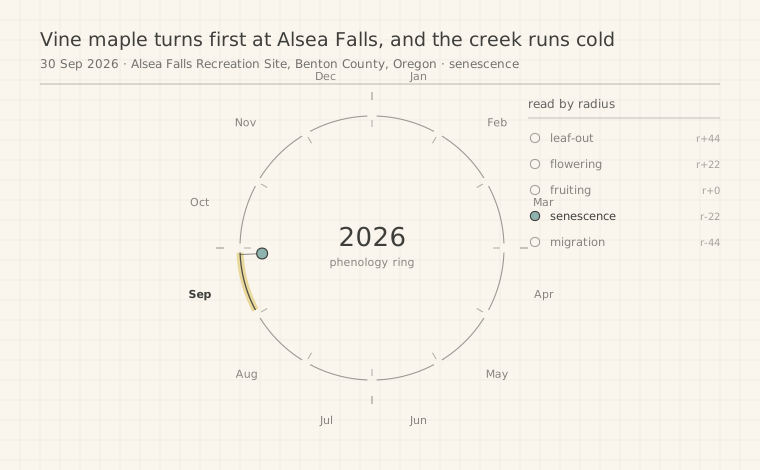
Vine maple is the first thing to turn in the Coast Range here, and it turns in the shade, low down, while the bigleaf maples above it are still green. Walking the same 200 m of trail every ten days is how I keep the two from blurring together.
Two scores, one drainage
- Vine maple, twelve tagged stems: 3.1 out of 5. Seven stems were at 3 or above; the most advanced, at the top of the bank where the soil is thinnest, was at 4.
- Bigleaf maple, eight tagged trees in the same 200 m: 1.6. None was above 2, and the two largest, both in deep soil by the creek, were at 1.
Vine maple grows in the understory and roots where its stems touch the ground, so it layers and spreads; a bigleaf maple stands alone in the open with its roots in deeper soil. The understory plant is colder at night, and its leaves are thinner. The fortnight between them is not a mystery, but I cannot yet say how much of it is the site and how much is the species.
What the creek says
The creek fell below 10°C for the first time this autumn: 9.8°C at 10:20, against 11.6°C on 20 September. That matters for the fish in this drainage — 10°C is roughly where coho and chinook begin to move in from the mainstem, and it is also where the last of the summer's algal growth shuts down.
One coastal giant salamander larva, 14 cm, under a stone in the riffle below the second bridge. The licorice ferns on the vine maple stems have started to unroll, which they do on the first wet week rather than on any particular date.
What to check next time
- Rescore both sets of tagged stems on 14 October. If the gap holds near a fortnight, that is a result; if it closes, the site is doing the work and not the species.
- Take the creek temperature at the same riffle every visit; the date it passes 10°C is worth having for ten years.
- Look for the first coho in this reach, which will be the sign the fish read the same number I am reading.
Observed
| Scientific name | Vernacular | Count | Note |
|---|---|---|---|
| Acer circinatum | vine maple | 12 | twelve tagged stems along 200 m of the trail, mean colour score 3.1 |
| Acer macrophyllum | bigleaf maple | 8 | eight tagged trees in the same 200 m, mean score 1.6 |
| Polypodium glycyrrhiza | licorice fern | 0 | recorded only: new fronds unrolling on the vine maple stems, the first of the season |
| Dicamptodon tenebrosus | coastal giant salamander | 1 | one larva under a stone in the creek, 14 cm long |
Reflection
Two maples, same drainage, same weather, two weeks apart. The difference is not something I can explain with my own records yet, which is exactly why the tagged trees matter.
Kit carried
- colour score card
- water thermometer
- 50 m tape
- flagging tape
- hand lens 10x
- waterproof notebook
- 2H pencil