Phenophase · fruiting August 2026
Garry oak acorns sizing up on the Finley ridge
The Garry oaks on the south ridge are carrying a heavy acorn crop, and the caps have started to lift. Measured 40 acorns across six trees: most are between 18 and 24 mm. Last year at this date the same trees had almost nothing.
| Date | Place | Finley National Wildlife Refuge, Benton County, Oregon | Weather | 19°C · clear, high haze · Wind N 3 m/s |
|---|
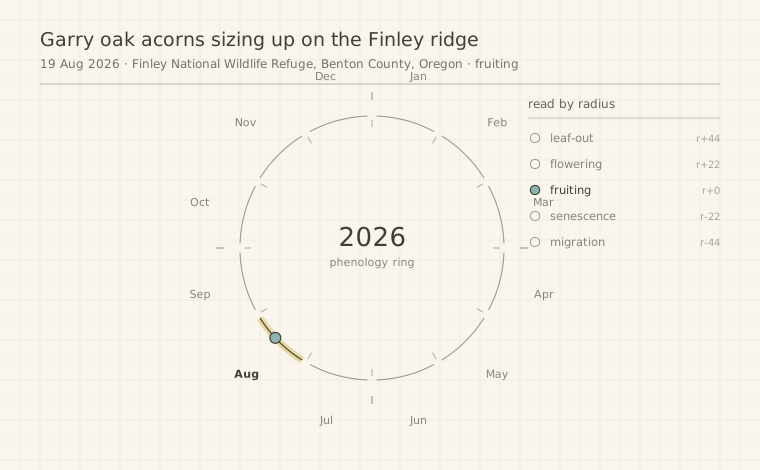
The south ridge at Finley is the most reliable oak ground I have, and this is the week the acorns stop being green beads and start looking like acorns. I came out to measure rather than to look, because "a heavy crop" is a sentence that means nothing a year later.
What the acorns are doing
Forty acorns from six Garry oaks, measured with the rule against the shell, not including the cap: 18 mm to 24 mm, with the median at 21 mm. The caps on the earlier trees have begun to lift at the seam, which is the first sign they are close to ripe. One tree on the east end of the ridge is running about a week behind the rest — its acorns are 15-17 mm and the caps are still tight.
Fruiting on this scale is not the usual case here. Last August I walked the same six trees on the 12th and found eleven acorns in total, most of them aborted and brown. The difference between a mast year and a lean one is decided the summer before, so this crop was set in 2025 and merely finished this month.
Weather and the shape of the visit
Nineteen degrees at 09:40, wind out of the north at about three metres a second, and a high haze that softened the light without cutting it. It is the eleventh dry day. The soil thermometer reads 21°C at five centimetres, in the open, between two oaks — warm enough that the grass on the ridge has gone from green to straw in a fortnight.
All of that matters to the acorns. A dry August concentrates sugars and slows the last of the sizing; a wet one can split the shells before the caps lift. Whatever rain comes in the next ten days will decide whether this crop finishes well or aborts part of itself now.
The rest of the ridge
The poison oak along the fence has already gone red, which it does before anything else here. Western bluebirds — four, in a loose family group — were working the fence posts for insects, and a Lewis's woodpecker called twice from the dead oak at the top of the ridge. Lewis's woodpeckers are the reason I keep coming back to this ridge in autumn: they arrive for the acorns and stay for the wasps.
Two Mormon metalmarks, one nectaring on yarrow, one patrolling the oak edge. The metalmark's whole life is tied to this ridge and to the wild buckwheat that grows with the oaks, which is a thing worth writing down in a year when the fuel load on the ridge is this high.
What to check next time
- Re-measure the same six trees on 2 September: acorns should be 22-26 mm and the caps loose on most.
- Watch for acorn woodpeckers caching in the snags — they have not shown up on this ridge yet this year.
- Note whether the first autumn rain splits any shells; that decides how much of this crop reaches the ground intact.
Observed
| Scientific name | Vernacular | Count | Note |
|---|---|---|---|
| Quercus garryana | Garry oak | 6 | six mature trees measured; acorns on all six |
| Toxicodendron diversilobum | Pacific poison oak | 1 | already turning red along the fence line |
| Apodemia mormo | Mormon metalmark | 2 | one nectaring on yarrow, one patrolling oak edge |
| Melanerpes lewis | Lewis's woodpecker | 1 | calling from a dead oak snag, first of the autumn here |
| Sialia mexicana | western bluebird | 4 | a family group working the fence posts for insects |
Reflection
The acorn crop is the thing I keep failing to photograph well. A picture flattens a heavy crop and a light one into the same green blur, so this year I am measuring instead: forty acorns, six trees, a rule. It took twenty minutes and it will mean something in November.
Kit carried
- 10x hand lens
- Rite in the Rain notebook
- 2H and 4B pencils
- 30 cm steel rule
- digital thermometer
- binoculars 8x42