Phenophase · flowering August 2026
Tarweed opens at nine and the bees are already waiting
Common tarweed on the Chip Ross ridge opens its heads between 09:10 and 11:40 on a clear August morning. Forty plants, forty minutes of watching, 63 bee visits in 20 minutes of counting.
| Date | Place | Chip Ross Park, Corvallis, Oregon | Weather | 24°C · clear, no cloud · Wind NW 2 m/s |
|---|
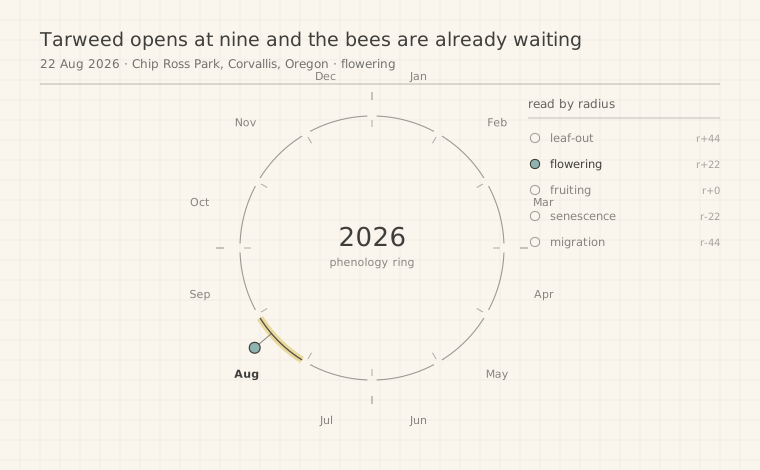
Tarweed smells like a bicycle tyre and pine sap, and it is the last big flowering event on the ridge before the autumn rains. I came up to settle a small question: does it really open its heads in the morning, or does it just look that way from the trail?
The heads open on a schedule
I picked forty plants in a belt 20 m long beside the upper trail and checked the same ten of them every ten minutes, from 08:30 to 12:30, on a clear day at 24°C with no cloud.
- 08:30 — every head closed, ray florets rolled inward, the whole plant in silhouette a row of small green beads.
- 09:10 — the first head on the sunward side of the belt opens; three more by 09:30.
- 10:00 — 22 of the 40 open.
- 11:40 — all 40 open, rays flat, the ridge yellow.
- 12:30 — still open, no sign of closing before evening.
The heads that open first are the ones on the south side of each plant, which is the side that warms first. That is not a coincidence; it is the whole mechanism.
Twenty minutes of counting
Between 10:05 and 10:25 I stood still and counted every insect that landed on an open head inside the belt: 63 visits.
- Yellow-faced bumble bees, 24. Two of them were already working closed heads at 09:40, pushing between the bracts for the pollen that is available before the flower opens.
- Tripartite sweat bees, 18, all in a ten-minute window in the middle of the morning.
- Honey bees, 13, none before 10:00.
- Woodland skippers, 3, at midday, when the bees had thinned out.
The order matters. The bumble bees are the ones that can force their way in early; the small sweat bees follow the opening; the honey bees follow the nectar.
What the resin does
The stems and the bracts are covered in glandular hairs that put out a clear resin, and by the end of the morning my hands smelled of it. Tarweed is sticky for a reason: the resin catches small crawling insects that would otherwise walk up the stem and take nectar without carrying pollen anywhere. A 10x lens on a stem shows the bodies stuck along it. That also makes tarweed a poor cut flower and a good plant to kneel beside rather than brush against.
What to check next time
- Count the same forty plants on 5 September to see whether the flowering peak has moved.
- Look for the seed heads after the first rain; tarweed drops seed within days of a wetting.
- Check whether the sticky bands catch more ants on the plants nearest the trail edge, where ant traffic is heaviest.
Observed
| Scientific name | Vernacular | Count | Note |
|---|---|---|---|
| Madia elegans | common tarweed | 40 | forty plants inside a 20 m belt along the ridge trail |
| Bombus vosnesenskii | yellow-faced bumble bee | 24 | 24 visits in 20 minutes; the first to arrive, before the heads were fully open |
| Halictus tripartitus | tripartite sweat bee | 18 | 18 visits, all between 10:05 and 10:35 |
| Apis mellifera | European honey bee | 13 | 13 visits, arriving only after 10:00 |
| Ochlodes sylvanoides | woodland skipper | 3 | three, nectaring on the open heads at midday |
Reflection
I have walked past tarweed for years without knowing it keeps office hours. Standing still for forty minutes to watch a flower open is the closest this journal gets to a time-lapse, and it cost me nothing but patience.
Kit carried
- 10x hand lens
- stopwatch
- tally counter
- Rite in the Rain notebook
- 2H pencil
- digital thermometer
- 30 cm steel rule