Phenophase · fruiting September 2026
Counting the hazelnut crop, and the weevils that got there first
Beaked hazelnuts on a 40 m transect at Peavy Arboretum gave 216 nuts, of which 31 per cent had the exit hole of the hazelnut weevil. That damage rate is the highest I have recorded on this transect and it tracks last winter's mild weather.
| Date | Place | Peavy Arboretum, McDonald-Dunn Research Forest, Oregon | Weather | 18°C · overcast, drizzle on and off · Wind SW 2 m/s |
|---|
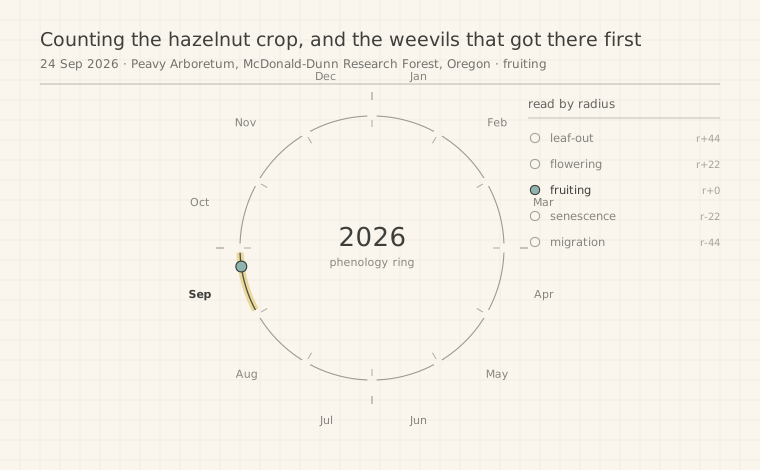
The hazelnut husks split in the last week of September here, and the weevil larvae leave at almost the same moment. Counting both at once is the only way to say anything useful about the crop.
The transect and the count
Forty metres along the north edge of the arboretum, uphill side of the trail, taking every beaked hazelnut shrub on the line: 24 shrubs. I picked all the nuts in the husk from four of them and counted the rest by eye.
- Nuts counted in the husk: 216, an average of 9 per shrub.
- Nuts with a circular exit hole about 2 mm across: 67, or 31 per cent.
- Nuts still green and hard, weeks from ripe: 29, all on the two most shaded shrubs.
- Empty husks already on the ground: about 40, cut by squirrels rather than weevils — squirrels cut the whole husk off, weevils leave the husk on the branch.
Reading the hole
The hazelnut weevil lays into the young nut in June. The larva eats the kernel through the summer, then chews an exit hole and drops to the soil to spend the winter, and the hole it leaves is round, clean-edged and about 2 mm across. A nut with a hole is an empty shell, and if you shake a handful the difference in sound is unmistakable once you have heard it once.
Thirty-one per cent is high for this transect. My records for the same four shrubs are 12 per cent in 2024 and 19 per cent in 2023. Weevil survival over winter depends on how cold the soil gets, and last winter the soil at 10 cm here never went below 3.4°C, which is mild enough that very few larvae died.
What eats what is left
Three Douglas squirrels were working the shrubs, and all three were cutting green husks and leaving them on the ground — a squirrel takes the nut and leaves the husk, which is how you tell squirrel work from weevil work at a glance. Under two shrubs I found small caches of nuts, ten to fifteen in each, every one of them sound and without holes. Deer mice are better at picking good nuts than I am.
What to check next time
- Recount the same four shrubs in 2027 to see whether the damage rate drops after a cold winter. That is the test of the temperature explanation.
- Collect 20 nuts and float them: sound nuts sink, weevil-damaged ones float, which is faster than looking for holes.
- Note whether the squirrels take the crop before it splits. If they do, the transect count will be short and I will need to count the husks on the ground instead.
Observed
| Scientific name | Vernacular | Count | Note |
|---|---|---|---|
| Corylus cornuta | beaked hazelnut | 24 | 24 shrubs on the transect, 216 nuts counted in the husk |
| Curculio obtusus | hazelnut weevil | 67 | 67 nuts with a circular exit hole, 31 per cent of the crop |
| Tamiasciurus douglasii | Douglas squirrel | 3 | three, cutting husks before they split and leaving the green husk on the ground |
| Peromyscus maniculatus | deer mouse | 0 | recorded only: caches under two shrubs, all of them sound nuts |
Reflection
Damage rates are the kind of number that only becomes interesting in its third year. This is year three, and the mild winter shows up in a way I would never have seen by looking at the shrubs.
Kit carried
- 2 m steel rule
- buckets
- hand counter
- 10x hand lens
- penknife
- waterproof notebook
- 2H pencil