Phenophase · senescence September 2026
Frost in the hollow, four degrees colder than the ridge
The first frost of autumn arrived on 21 September and only in the hollow: minus 0.5°C at 06:40 on the valley floor of the oak savanna against plus 4.2°C on the ridge 40 m above it, with blackberry leaves frozen on one side of the road and untouched on the other.
| Date | Place | Finley National Wildlife Refuge, Benton County, Oregon | Weather | 4°C · clear, calm, no wind at all · Wind calm |
|---|
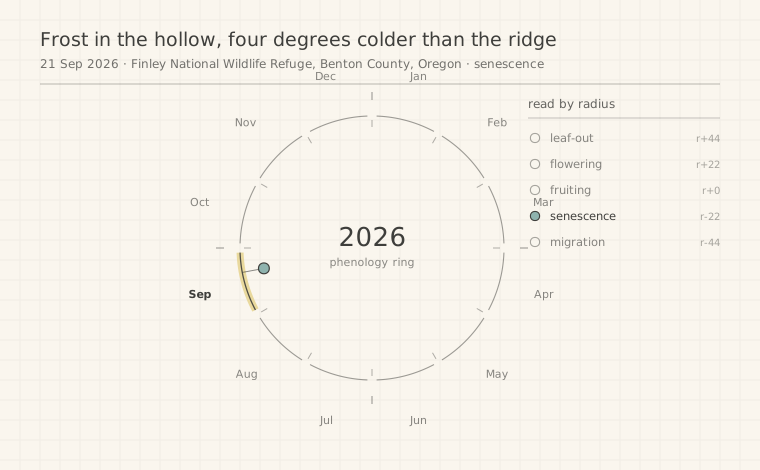
The first frost of the season is almost never a frost over the whole refuge. It happens in the low places, on the ground, on the first still clear night after a front goes through, and today was exactly that night.
Two thermometers, forty metres apart
I carried both a min-max thermometer and an infrared one, and read the same three points before sunrise and again at 11:00.
- Hollow floor, at grass height, 06:40 — minus 0.5°C. The min-max had recorded minus 0.7°C at about 05:30.
- Ridge top, 40 m higher, in the open, 06:40 — plus 4.2°C. That is a difference of nearly five degrees over a walk of four minutes.
- Bare soil in the hollow at 5 cm — 8.1°C, which is why the frost was on the leaves and not in the ground.
The blackberry along the road made the boundary visible: frosted, limp and dark on the hollow side, untouched thirty metres away where the road rises. Frost on the leaf and not in the soil is the mark of a radiation frost, and a radiation frost needs a still night. There was no wind at all, not even in the treetops.
What that means for the season
A radiation frost does not end the growing season; it takes the top off it. One night freezes the exposed leaf of a blackberry and the top of the grass, and then the next three nights are mild again. The plants that matter here — the oaks, the hawthorns, the ash — hold their leaves for another five or six weeks, and every one of them was undamaged.
The birds had already responded. Fourteen green-winged teal on the seasonal pond, against four on 14 September. About thirty robins in a loose flock, the first flock of the autumn here, working the hawthorn for fruit. And one monarch heading south along the ridge at 11:00, on a day with no wind to help it.
What to check next time
- Re-read the same three points on the next still night to see whether the hollow freezes again or the frost was a one-off.
- Note how far up the slope the frost line sits on the blackberry. On a colder night it should climb.
- Start counting teal weekly; the pond fills before the rain does, and the birds track the frost rather than the water.
Observed
| Scientific name | Vernacular | Count | Note |
|---|---|---|---|
| Rubus bifrons | Himalayan blackberry | 0 | recorded only: leaves frosted and limp on the hollow side, undamaged on the ridge side |
| Quercus garryana | Garry oak | 0 | recorded only: no frost damage visible on any oak, 4 m above the ground in every case |
| Danaus plexippus | monarch | 1 | one, heading south along the ridge at 11:00, the first I have seen here this year |
| Anas crecca | green-winged teal | 14 | fourteen on the seasonal pond, up from four on 14 September |
| Turdus migratorius | American robin | 30 | about thirty in a loose flock on the hawthorn, the first flock of the autumn |
Reflection
Frost is local in a way that weather forecasts are not. Walking the same transect at dawn twice a week through October is the only way I know to show someone that the cold air in a hollow is a thing you can stand in.
Kit carried
- min-max thermometer
- infrared thermometer
- 10x hand lens
- Rite in the Rain notebook
- 2H pencil
- soil thermometer