Phenophase · senescence October 2026
Black cottonwoods drop their leaves into the Luckiamute in a fortnight
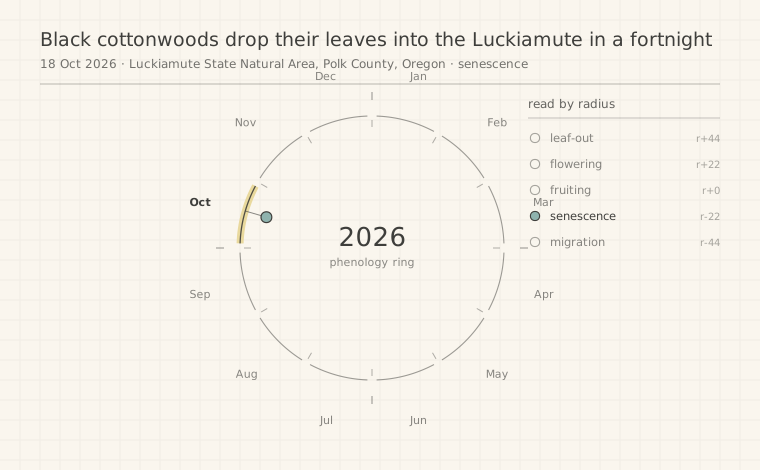
Eight tagged black cottonwoods at Luckiamute went from 30 per cent to 92 per cent leaf fall in thirteen days, the fastest fall of any tree on this reach, and the leaves are going straight into the river rather than onto the bank.
| Date | Place | Luckiamute State Natural Area, Polk County, Oregon | Weather | 10°C · clear, fog until 11:00 · Wind calm |
|---|
The cottonwoods on the Luckiamute grow right on the lip of the bank, which means most of their leaves never touch soil. They fall in the water and move downstream, and that has consequences for everything below them.
Thirteen days of leaf fall
- 5 October: eight tagged trees at 30 per cent defoliation, the ground under them covered but the crowns still full.
- 12 October: 71 per cent. Two of the eight were nearly bare.
- 18 October: 92 per cent. Only the trees furthest from the water still held a few leaves.
For comparison, six Oregon ash on the same reach were at 45 per cent on 18 October, and five Pacific willows were still 80 per cent leafed with no yellow in them at all. Cottonwood is early, fast and complete; willow is late and unbothered.
Why it matters where the leaves land
A leaf that falls on the bank stays where it is and decomposes slowly in the air. A leaf that falls in the river is a different object: it is food for shredding invertebrates within days, and the shredders are food for the fish. On this reach the cottonwoods overhang about 60 per cent of the bank length, which makes them the largest single source of leaf litter in the water.
Eight tagged trees, a 40 cm rise in the river since 1 October, and a water temperature of 9.1°C. Coho move into the tributaries at about this temperature and two dark fish were holding in the pool below the cottonwoods, which is the sequence the whole note is about: leaves, shredders, fish.
What to check next time
- Estimate the proportion of the bank length overhung by cottonwood on this reach, and tell the two banks apart when you do it.
- Take a litter sample from the water at the same riffle in November to see what is left of this fall.
- Check whether the willows drop before the first frost. If they do not, they are a different strategy rather than a later version of the same one.
Observed
| Scientific name | Vernacular | Count | Note |
|---|---|---|---|
| Populus trichocarpa | black cottonwood | 8 | eight tagged trees, 30 per cent defoliated on 5 October and 92 per cent on 18 October |
| Fraxinus latifolia | Oregon ash | 6 | six tagged trees on the same reach, only 45 per cent down |
| Salix lasiandra | Pacific willow | 5 | five, still 80 per cent leafed and no yellow showing |
| Ardea herodias | great blue heron | 3 | three on the gravel bar by the second bend |
| Oncorhynchus kisutch | coho salmon | 2 | two, dark and holding in the pool below the cottonwoods |
Reflection
Trees that drop their leaves into water are doing something different from trees that drop them on soil, and the difference is only visible if you draw it. That cross-section is the most useful thing in this note.
Kit carried
- water thermometer
- wading staff
- 50 m tape
- flagging tape
- litter net
- notebook
- 4B pencil