Phenophase · migration October 2026
The sparrow flock builds at Jackson-Frazier, and the water comes up with it
A fixed 200 m walk at Jackson-Frazier on 15 October produced 63 sparrows of five species, against 11 on 24 September. The water table rose 14 cm in three weeks and the boardwalk is flooded at two points.
| Date | Place | Jackson-Frazier Wetland, Benton County, Oregon | Weather | 12°C · overcast, 6.2 mm rain overnight · Wind SW 4 m/s |
|---|
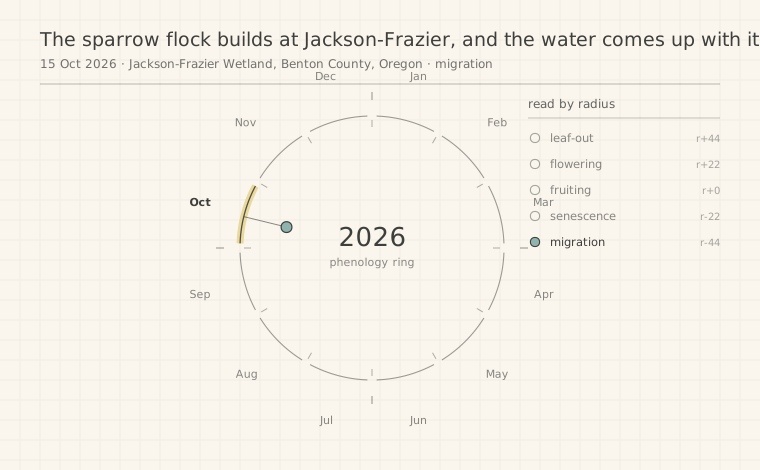
Jackson-Frazier is a wetland that behaves like a sponge: it fills in October and drains in June, and the birds that winter here arrive as it fills. Today the water and the birds came together, which is the pattern but not always the timing.
The same walk, three weeks apart
I walk the same 200 m of boardwalk and count every sparrow, in the same order, at the same time of morning.
- 24 September: 11 sparrows of two species (song, white-crowned).
- 15 October: 63 sparrows of five species.
- Mallards: 12 to 31.
- Water level: 14 cm higher than 24 September, and the boardwalk is under 5 cm of water at two points, which I noted with wet feet.
White-crowned sparrows made up most of the increase: 24 today, and they are the birds that arrive from the north in October and stay until April. The dark-eyed juncos arriving in a flock of 14 are the other change; they feed on the ground along the edge of the boards, and in a month they will be the commonest bird here.
Telling the arrivals apart from the residents
Song sparrows sing in autumn as well as in spring, and 18 birds with most of them singing means resident birds holding territories plus some northern arrivals. White-crowned and golden-crowned sparrows do not sing here in winter at all, so every one of the 29 birds in those two species is an arrival. That is a useful distinction: a count with song in it tells you less than a count without.
What to check next time
- Repeat the walk on 5 November to find the peak of the arrival, which in my records is between 25 October and 10 November.
- Read the water staff at the same point each visit; the wetland fills in steps after storms, not smoothly.
- Listen for the fox sparrow's double scratch in the litter, which is more reliable than seeing the bird.
Observed
| Scientific name | Vernacular | Count | Note |
|---|---|---|---|
| Zonotrichia leucophrys | white-crowned sparrow | 24 | 24, the largest single group, in the rose and willow edge |
| Melospiza melodia | song sparrow | 18 | 18, most of them singing, so probably resident birds plus arrivals |
| Junco hyemalis | dark-eyed junco | 14 | 14, on the ground along the boardwalk, the first flock here this autumn |
| Zonotrichia atricapilla | golden-crowned sparrow | 5 | five, with the white-crowns, told apart by the yellow crown and grey throat |
| Passerella iliaca | fox sparrow | 2 | two, scratching in the litter under the ash, first of the season here |
| Anas platyrhynchos | mallard | 31 | 31 on the open water, up from 12 on 24 September |
Reflection
A sparrow flock in a wetland is mostly brown and grey and hard to count honestly. Doing the same 200 m walk on the same route every three weeks is the only part of it I trust.
Kit carried
- binoculars 8x42
- water level staff
- tally counter
- rain gauge
- notebook
- 2H pencil
- wellingtons