Phenophase · fruiting October 2026
Chanterelles fruit three days after the soil passes 12°C
A chanterelle flush appeared on a fixed 60 m transect at Oak Creek on 27 October, three days after the soil at 10 cm fell below 12°C for the first time and the first heavy rain of the autumn arrived.
| Date | Place | Oak Creek, McDonald-Dunn Research Forest, Oregon | Weather | 11°C · overcast after 21 mm of rain in two days · Wind S 3 m/s |
|---|
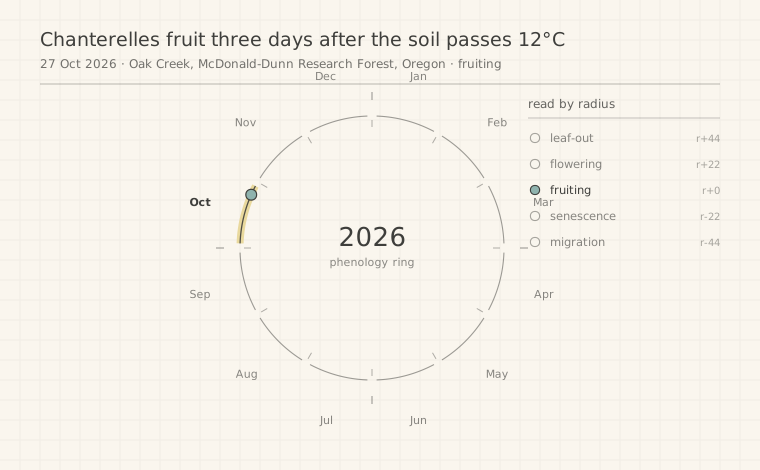
The autumn mushroom flush is the most visible thing that happens in this forest, and the least understood by the people who walk it. I count fruit bodies on a fixed transect to see how the flush tracks soil temperature and rain.
Three days after the trigger
- 22 October: soil at 10 cm under litter, 14.1°C, no fruit bodies on the transect.
- 25 to 26 October: 21 mm of rain in two days.
- 26 October: soil at 10 cm, 11.9°C, the first reading below 12°C this autumn.
- 27 October: 34 chanterelle fruit bodies on the 60 m transect, 21 of them under 3 cm across, which is to say they came up in the last three days rather than being missed last week.
Rain alone does not do it. The soil has to be cold enough first, and the heavy rain of September, which dropped 24 mm in one night with the soil still at 16°C, produced nothing on this transect at all.
What was there and where
- 34 Pacific golden chanterelles, every one of them within 4 m of a Douglas-fir, most of them on the slope side of the trunk.
- 6 panthercaps, all under fir, and none of them touched.
- 3 pig's ears on the bank above the creek, my first record here since 2023.
- 4 crimson waxcaps in the mossy gap, standing out in flat light because there is nothing else that colour in the forest.
I pick nothing on the transect. Fruit bodies are counted in place and left, because a transect you harvest is a transect you have only one year of.
Why the caution is part of the note
A chanterelle has forking ridges that run down onto the stem; a true agaric has gills that hang free. That single difference is what keeps people out of trouble, and it is the reason the sketch prompt for this note asks for the ridges and the gills side by side rather than a description. Two of the species on this transect, the panthercap and the waxcaps, will make you ill, and none of them is worth an evening in a hospital. Nothing in this journal is a foraging guide.
What to check next time
- Count the same transect weekly through November to get the shape of the flush rather than a single peak.
- Record soil temperature at 10 cm every visit; 12°C is the number I am testing.
- Look for the second flush after the next heavy rain, which usually follows three to four weeks later in this forest.
Observed
| Scientific name | Vernacular | Count | Note |
|---|---|---|---|
| Cantharellus formosus | Pacific golden chanterelle | 34 | 34 fruit bodies on the 60 m transect, 21 of them under 3 cm |
| Amanita pantherina | panthercap | 6 | six, all under Douglas-fir, noted and not touched |
| Gomphus clavatus | pig's ear | 3 | three on the bank above the creek, my first here since 2023 |
| Pseudotsuga menziesii | Douglas-fir | 10 | ten trees along the transect; every chanterelle was within 4 m of one |
| Hygrocybe punicea | crimson waxcap | 4 | four in the mossy gap above the transect, bright in flat light |
Reflection
I record fungi as evidence of what the soil is doing, and I want to be plain about it: this journal is not a foraging guide. Two mushrooms on this transect will make you ill and one of them looks nothing like a chanterelle until you turn it over.
Kit carried
- soil thermometer
- 50 m tape
- GPS
- basket
- wax paper
- 10x hand lens
- notebook
- 2H pencil