Phenophase · senescence October 2026
Fog fills the valley and the hill is nine degrees warmer
On 24 October the temperature fell 9.4°C from the top of Bald Hill to the valley floor, a full inversion, and the fog line sat at 180 m. The two zones were in different seasons: frosted and grey below, sunny and 15°C above.
| Date | Place | Bald Hill, Benton County, Oregon, 30 m to 250 m elevation | Weather | 6°C · fog below 180 m, clear above · Wind calm below the fog, SW 2 m/s above |
|---|
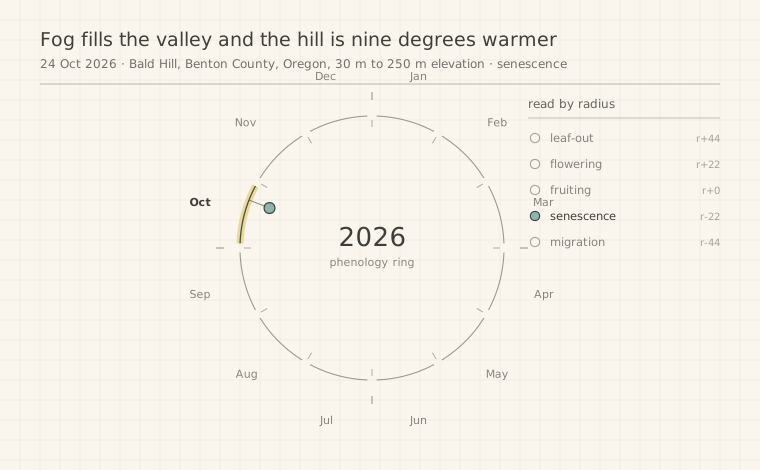
Every clear calm night in late October builds the same thing: cold air draining off the slopes and pooling in the valley floor, with warmer air sitting on top of it. By morning the valley is in fog and the hill is in sun.
Nine degrees over two hundred and twenty metres
I walked from the car park at 90 m to the summit at 250 m, reading the thermometer at each of five points, at 08:10 and again at 13:00.
- Valley floor, 90 m, 08:10 — 5.8°C, fog, visibility 70 m, everything dripping.
- 150 m, 08:10 — 7.1°C, still inside the fog, the fog line visible just above.
- 180 m, 08:10 — 10.9°C, out of the fog and into sun.
- 250 m, summit, 08:10 — 15.2°C, clear, dry, no wind.
- Valley floor at 13:00 — 6.4°C, fog still in place; the inversion had not broken.
Top to bottom at the same moment: 9.4°C. The fog never lifted all day, which is what a strong inversion does in this valley: the sun cannot burn through it in late October because there is not enough of it.
Two seasons on one hill
The fog zone was frosted at ground level and had been wet for days; the blackberry at the base of the hill was black and limp. Above 180 m the same species was green and undamaged, and the oaks on the ridge were two colour stages further on than the oaks in the fog. That is the part that surprises people: the hill is not simply warmer, it is a different season, because it gets sun and the valley does not.
I heard American wigeon calling from the wet field below in the fog and never saw them. The barometer read 1021 hPa and steady, which is the other half of the recipe: high pressure, no wind, long nights.
What to check next time
- Read the same five points on a windy day to show what mixing does to the difference.
- Note the elevation of the fog line each visit; my records from 2024 put it between 120 m and 240 m through November.
- Look for the frost line below the fog. In a strong inversion the coldest air is at the very bottom, not at the edge of the fog.
Observed
| Scientific name | Vernacular | Count | Note |
|---|---|---|---|
| Pseudotsuga menziesii | Douglas-fir | 0 | recorded only: the fog zone trees were dripping, the ridge trees were dry |
| Quercus garryana | Oregon white oak | 0 | recorded only: leaf colour above the fog line was two stages ahead of the trees in the fog |
| Rubus bifrons | Himalayan blackberry | 0 | recorded only: frosted at the base of the hill, green at the top |
| Anas americana | American wigeon | 0 | recorded only: heard calling in the fog from the wet field, not seen |
Reflection
The inversion is the most striking thing that happens here in autumn and it lasts for weeks. Walking a hill with two thermometers is the only way to show someone that the valley and the hill are in different weather.
Kit carried
- two thermometers
- hygrometer
- aneroid barometer
- hand lens
- notebook
- 2H pencil
- headlamp