Phenophase · migration August 2026
Green darners are moving south over Marys Peak
Forty-one common green darners passed south over the Marys Peak summit meadow during three twenty-minute watches on 28 August, all of them on the same line along the ridge, all heading into a north wind.
| Date | Place | Marys Peak summit meadow, Benton County, Oregon | Weather | 18°C · clear above, valley fog below 600 m · Wind N 4 m/s |
|---|
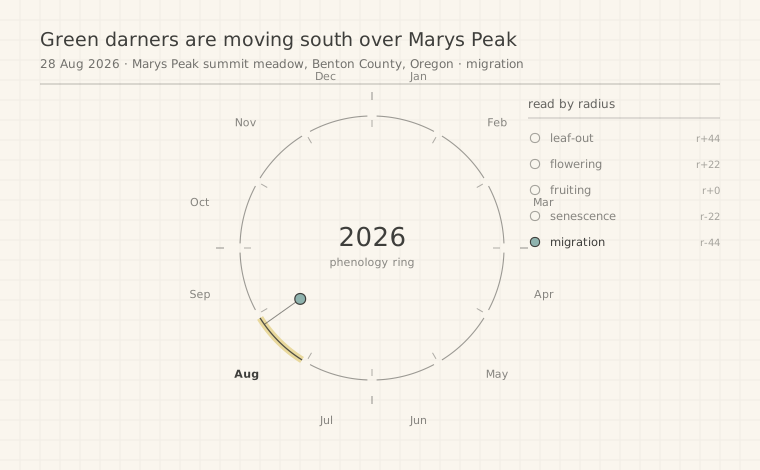
Marys Peak is the highest thing in this county and the one place where a flight line becomes visible. I came up for the beargrass seed heads and stayed for the dragonflies.
Three watches, one line
I stood at the same spot on the summit meadow, at the top of the gravel track, and counted anything with a wingspan over 8 cm crossing a line between two fence posts.
- 10:40 to 11:00 — 14 southbound, all within 15 m of the ridge line, all between 3 m and 8 m above the ground.
- 11:20 to 11:40 — 18 southbound, and by now they were coming through in twos and threes rather than singly.
- 12:10 to 12:30 — 9 southbound, and nothing at all heading north.
Forty-one green darners in an hour of watching, every one of them heading south into a north wind. That is the part that surprises people: the flight is not a drift downwind, it is a track along a ridge, and the wind was against them the whole time.
What else was flying
Not everything on the wing was migrating. Six paddle-tailed darners were hunting the meadow edge, working back and forth over the same twenty metres of grass and never once heading anywhere. Nine variegated meadowhawks were perched on the gravel and only flew when I walked past them.
The difference is easy to see once you know what to look for: a migrant flies in a straight line with a fixed heading and does not turn for anything; a hunter loops, doubles back, and ends up over the same patch of grass it started on.
What a darner needs to make the trip
A green darner crossing a mountain pass in a north wind is a large insect with a small fuel tank. The ones I looked at closely were all mature males, the abdomen blue rather than green-yellow, and all of them were flying on the lee side of the ridge where the wind was weakest. They stop to hunt, and a meadow with a late flush of small flies is worth more to them than a shortcut.
What to check next time
- Watch the same line on 4 September: the tail of the migration should be smaller-bodied and duller.
- Note whether the flight stops when the wind turns south, which would confirm that the heading is chosen rather than imposed.
- Check the pond below the summit for larvae, which would tell you whether part of the year's generation is local.
Observed
| Scientific name | Vernacular | Count | Note |
|---|---|---|---|
| Anax junius | common green darner | 41 | 41 southbound in three 20-minute watches, all on the ridge line |
| Aeshna palmata | paddle-tailed darner | 6 | six, hunting the meadow edge rather than travelling |
| Sympetrum corruptum | variegated meadowhawk | 9 | nine, most of them perched on the gravel rather than flying |
| Xerophyllum tenax | beargrass | 0 | recorded only: seed heads dry, the meadow is finished for the year |
Reflection
I have read about darner migration for years and assumed it happened somewhere else. Standing on a ridge in a north wind and counting them is a different kind of knowing, and it took three watches of twenty minutes each to be sure of what I was seeing.
Kit carried
- stopwatch
- tally counter
- wind meter
- binoculars 8x42
- Rite in the Rain notebook
- 4B pencil