Phenophase · fruiting August 2026
The Douglas-firs are dropping a heavy cone crop at Bald Hill
A cone count under ten Douglas-firs at Bald Hill Farm comes to a mean of 31 cones per square metre, with fresh squirrel middens at six of the ten trees. The 2026 cone crop here is the heaviest I have counted since 2022.
| Date | Place | Bald Hill Farm, Benton County, Oregon | Weather | 26°C · clear, smoke haze at the horizon · Wind SW 3 m/s |
|---|
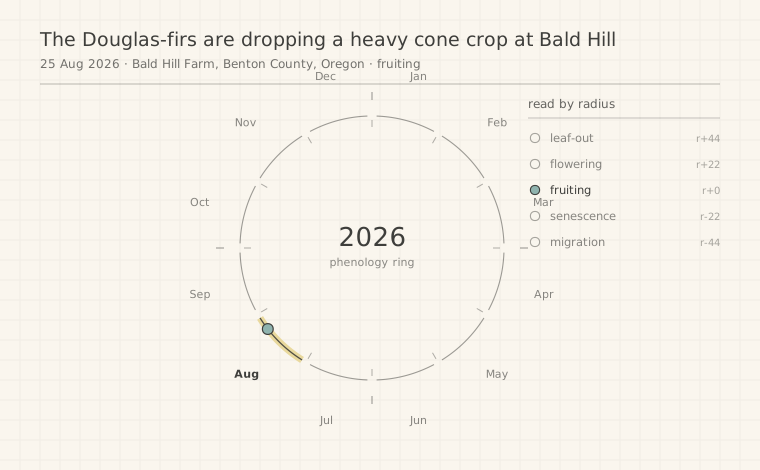
Every third or fourth year the Douglas-firs here do this, and this is one of those years. The gravel under the tall firs at the top of the pasture is covered, and the squirrels have started building middens.
Counting the crop
I sampled ten firs along the fence line, avoiding the two at the gate that get walked under. At each tree I laid a 1 m2 wire quadrat in three places — upslope, downslope and under the drip line — and counted every cone inside it, whole or chewed.
- Mean across the ten trees: 31 cones per square metre.
- Heaviest tree: 58 per square metre, the tallest fir on the north end.
- Lightest tree: 9 per square metre, a suppressed fir in the shade of the others.
- Cut or chewed cones: about one in six, all with the scales stripped back to the rachis, which is squirrel work rather than insect work.
For comparison, the same ten trees gave a mean of 4 per square metre in 2024 and 47 in 2022. A crop like this is set a year in advance, so the 2026 cones were pollinated in the spring of 2025 and have been filling all summer.
What the squirrels are doing about it
Middens — the piles of stripped cores, cone scales and husks where a squirrel does its feeding — are fresh at six of the ten trees. A midden is worth counting because it is the clearest evidence of territory: a Douglas squirrel will defend one cache pile all winter, and a good midden under a heavy crop is the difference between a squirrel that stays and a squirrel that does not.
Two animals were calling from the firs at the north end and one crossed the trail with a cone in its mouth at 11:20. A red crossbill group of five was working the top of the two tallest trees, hanging upside down and prying scales apart for the seed.
Why the crop matters past the firs
A heavy cone year feeds more than the squirrels. Crossbills move to wherever the crop is, so a good year here means birds that would otherwise be north of us; a failure means they leave. The same seed ends up in the litter and on the soil surface, and the seedlings that come out of it in 2028 will mostly be where this year's cones fell, not where the cones of a lean year fell.
What to check next time
- Re-count one tree in late September to see what proportion of the crop has been taken.
- Look for seedling cotyledons in spring 2028 in the two quadrat spots under the heaviest tree.
- Listen for crossbills again in October: a resident flock stays, a wandering one moves on.
Observed
| Scientific name | Vernacular | Count | Note |
|---|---|---|---|
| Pseudotsuga menziesii | Douglas-fir | 10 | ten crop trees sampled, cones counted in three quadrats each |
| Tamiasciurus douglasii | Douglas squirrel | 6 | fresh middens under six of the ten trees; two animals seen and heard |
| Loxia curvirostra | red crossbill | 5 | a group working the cones in the two tallest firs |
| Sciurus griseus | western gray squirrel | 1 | one on the oak edge, not using the firs today |
| Arbutus menziesii | Pacific madrone | 0 | noted only for the ripening fruit on the south slope |
Reflection
A heavy cone crop is easy to claim and hard to prove. Counting cones in a wire square is a crude method and I know it, but a number I can repeat in three years is worth more than an impression I cannot.
Kit carried
- 1 m2 wire quadrat
- tally counter
- 10x hand lens
- Rite in the Rain notebook
- 2H pencil
- 30 cm steel rule
- binoculars 8x42