Phenophase · senescence September 2026
Bigleaf maples turn a fortnight late on the coast at Yachats
Twelve tagged bigleaf maples along the Yachats River show a colour score of 0.8 out of 5 on 6 September, against 2.4 for the same stage inland. The coastal lag is about a fortnight and it is not explained by temperature alone.
| Date | Place | Yachats River road and Cape Perpetua, Lincoln County, Oregon | Weather | 16°C · low cloud until 11:00, then sun · Wind W 5 m/s, salt in the air |
|---|
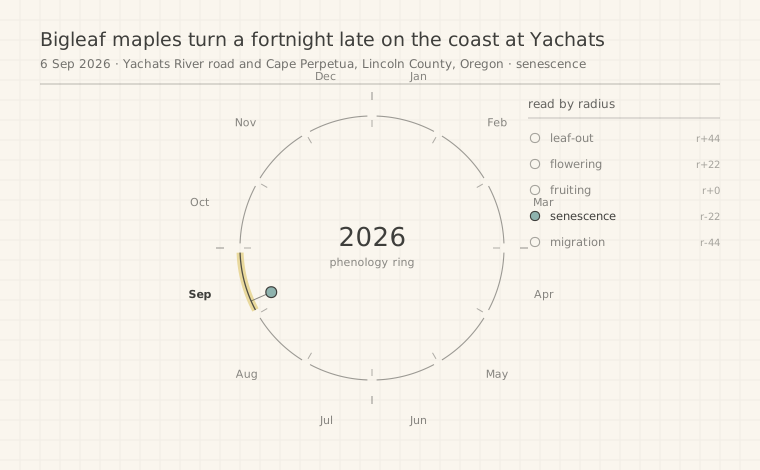
The inland maples I walk past in Corvallis are already showing yellow at the margins. On the coast, twelve tagged trees along the Yachats River are barely started, and that gap is the reason for this note.
Scoring instead of describing
Colour is the easiest thing in phenology to describe badly, so I use a fixed scale and the same trees every visit:
- 0 — fully green, no yellow visible at arm's length.
- 1 — yellow at the leaf margins only, less than a tenth of the leaf area.
- 3 — roughly half the canopy yellow or orange.
- 5 — bare, or the last few leaves brown and hanging.
On 6 September: nine of the twelve trees scored 1, two scored 0, and one tree at the bend, which grows in shallow soil over rock, scored 2. Mean 0.8. On the same day the inland trees I score in Corvallis were at 2.4, and one street tree was at 4.
Why the coast runs late here
The obvious answer is temperature, and it is only part of it. The coast is cooler in summer, which slows the season, but it is also warmer in autumn, because the ocean holds the heat. My logger at the Yachats road read a mean of 14.1°C for the first five days of September, against 16.9°C inland, and the coast has not yet had a night below 9°C while Corvallis has had four.
The other half is water. The gauge caught 0.6 mm overnight, and none of it was rain — it was fog drip off the canopy. A maple with its feet in fog in September is not under the same water stress as one in the valley, and it holds its leaves longer.
What lives on a maple that keeps its leaves
The licorice fern and the lace lichen on these trunks are the reason I keep walking this road. Both are wet-season plants that go dormant in summer and start growing the moment fog or rain returns, and 21 clumps of fern on the twelve tagged trunks were all green and putting out new fronds. Two flocks of chestnut-backed chickadees were working the lace lichen on the seaward side of the trunks, which is where it grows thickest.
Salal berries were ripe and black and almost untouched, which is early September for you: the fruit is there and the birds that will eat it are still inland.
What to check next time
- Rescore the twelve trees on 20 September and 4 October to get the coastal curve rather than a single point.
- Weigh one fern clump's new frond growth against the fog-drip record, which would tie the growth to the water rather than to the light.
- Look for the first flock of varied thrushes in the salal. Inland they arrive before the coast.
Observed
| Scientific name | Vernacular | Count | Note |
|---|---|---|---|
| Acer macrophyllum | bigleaf maple | 12 | twelve tagged trees scored 0-5 for colour; mean 0.8 |
| Polypodium glycyrrhiza | licorice fern | 21 | 21 clumps on the tagged trunks, all still green and growing |
| Ramalina menziesii | lace lichen | 0 | recorded only: hanging in the canopy, more of it on the seaward side |
| Gaultheria shallon | salal | 0 | recorded only: fruit ripe and black, picked by nothing yet |
| Poecile rufescens | chestnut-backed chickadee | 7 | seven in two flocks working the lichen on the trunks |
Reflection
The coast keeps its own calendar and I keep forgetting it. Tagging trees costs a morning and a roll of flagging tape, and it is the only way I will ever know whether the fortnight I keep claiming is real.
Kit carried
- colour score card
- 50 m tape
- hygrometer
- rain gauge
- 10x hand lens
- waterproof notebook
- 4B pencil
- flagging tape