Phenophase · migration September 2026
The first chinook are on the redds in Fall Creek
Eleven chinook and six redds in 1.2 km of Fall Creek on 9 September, with water at 11.4°C. The first redds here appear within a week of the temperature dropping below 12°C, which it did on 6 September.
| Date | Place | Fall Creek, Middle Fork Willamette drainage, Lane County, Oregon | Weather | 17°C · clear, low sun in the gorge · Wind calm |
|---|
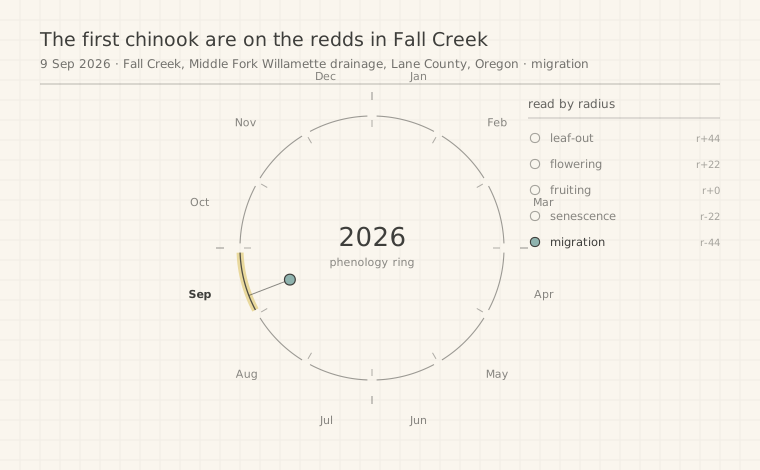
Fall Creek runs clear and cold out of the Cascades, and the chinook come up it in September. Today the water was at 11.4°C, which is the first reading under 12°C this season, and the fish were already on gravel.
Walking the reach
I walked 1.2 km of the reach from the bridge down to the second bend, with polarised glasses, counting anything over 40 cm. Walking downstream is easier: the fish face upstream and you see them before they see you.
- Live chinook: 11. Six were on redds — three females digging or holding, three males alongside. Four were holding in the deep pool below the second bend. One moved upstream past me at about 12:30.
- Redds: 6. All in riffles with a gravel size of roughly 2 to 8 cm, none in the pools and none where the bed is armoured with cobble larger than my hand.
- Redd size: 1.9 to 3.1 m long, 1.1 to 1.6 m wide, measured with a tape from the bank.
- Carcasses: 1 fresh, on the bar above the second redd, with crows on it.
Why the temperature matters
A chinook redd is not a nest so much as a hole and a pile: the female turns on her side and drives her tail into the gravel, washing a pit at the head and letting the tailings build a mound downstream. She lays into the pit, the male spawns over it, and the next dig covers the eggs. The whole thing only starts when the water falls below about 13°C, because that is the temperature at which the eggs survive best.
The first redd I found this year is at the same riffle as the first redd I found in 2024, which is not surprising — the groundwater coming in at that spot keeps it a degree or two colder than the rest of the reach. Water temperature is the trigger, and the creek has its own cold spots.
What the rest of the creek is doing
Nine rainbow trout were holding below the first redd, in the tail-out where the current brings things past them; drifting eggs are a large part of a trout's autumn. Two dippers were working the same water, and one of them was feeding in the shallows at the head of the redd, which is where the eggs are.
What to check next time
- Count again on 23 September, when the run should peak here, and record live fish and redds separately.
- Take the water temperature at the same riffle before and after the count, at 08:00 and 14:00, to see the daily range the eggs are sitting in.
- Look for the first spawned-out females and note how far downstream the carcasses travel. That is the nutrient subsidy this reach gets from the ocean.
Observed
| Scientific name | Vernacular | Count | Note |
|---|---|---|---|
| Oncorhynchus tshawytscha | chinook salmon | 11 | eleven live fish in 1.2 km: six on redds, four holding in pools, one moving up |
| Oncorhynchus mykiss | rainbow trout | 9 | nine, most of them below the first redd, waiting for eggs to drift |
| Cinclus mexicanus | American dipper | 2 | two working the tail of the third pool |
| Corvus brachyrhynchos | American crow | 6 | six on the gravel bar above the second redd, on a carcass |
Reflection
Redds are the easiest large event in this drainage to miss entirely, because from the road the creek looks like the same creek. Counting them means walking the whole reach with polarised glasses and no shortcuts, which is exactly what a number requires.
Kit carried
- polarised glasses
- water thermometer
- 2 m tape
- tally counter
- wading staff
- Rite in the Rain notebook
- 4B pencil