Phenophase · senescence October 2026
Measuring leaf fall under the white oaks at Bald Hill
Six litter traps under Oregon white oaks collected 41 grams of dry leaf per square metre between 5 and 12 October, and the oaks were at 62 per cent leaf fall against 18 per cent for the same-day ash trees.
| Date | Place | Bald Hill Farm, Benton County, Oregon | Weather | 11°C · clear, first light frost on the car roof · Wind E 3 m/s |
|---|
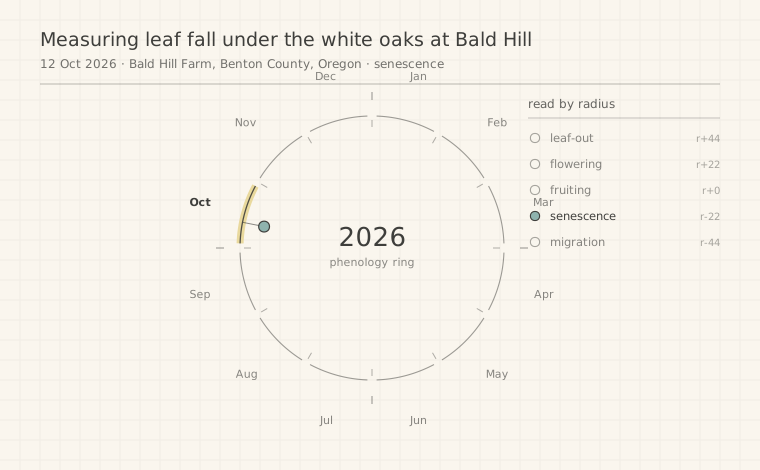
Leaf fall is the slowest obvious thing in autumn. You cannot see it happening, but you can catch it, and six traps and a spring balance turn it into a number that can be compared with next year.
What the traps caught
Six traps of 0.25 square metres, two under each of three oak crowns, emptied on 5 October and again on 12 October:
- Dry weight per trap for the week: 9.1 g to 12.8 g, mean 10.6 g.
- Converted to a square metre: 41 g of dry leaf per square metre of ground in seven days.
- Species in the traps: 88 per cent oak, 7 per cent ash from further up, 5 per cent grass and road dust.
- Estimated defoliation on 12 October: oaks 62 per cent, bigleaf maples 70 per cent, Oregon ash 18 per cent.
The ash trees are at the bottom of the slope on wetter soil, and they hold their leaves later than anything else on this farm. In 2024 the ash was still half leafed on 20 November.
Why the wind matters
Leaf fall is not only about the tree; it is about the wind that removes what the tree has already let go. Monday was calm and the traps collected 3 g each. Tuesday and Wednesday had a dry east wind at 3 to 5 metres a second and the traps collected three times as much. The abscission layer at the base of each leaf stalk is formed by the tree — once it is complete the leaf is only held by its own weight — and a wind event strips a week of leaf fall into an afternoon.
What else is using the litter
Three black-tailed deer under the oaks, all eating acorns and ignoring leaves. The acorn crop here is the same one I measured in August: heavy. A deer taking acorns is competing with the woodpeckers and the pigeons, and the litter layer is where the leftovers go.
What to check next time
- Empty the traps again on 19 October. The weekly rate should be falling by then if the oaks are close to finished.
- Weigh the ash traps separately and compare them in December, since that species is a fortnight behind.
- Look for acorn shells in the traps; that is the cheapest way to index how much of the crop has already been taken by animals.
Observed
| Scientific name | Vernacular | Count | Note |
|---|---|---|---|
| Quercus garryana | Oregon white oak | 6 | six tagged trees; traps gave a mean 41 g dry leaf per square metre in a week |
| Fraxinus latifolia | Oregon ash | 4 | four tagged trees at the bottom of the slope, only 18 per cent defoliated |
| Acer macrophyllum | bigleaf maple | 3 | three trees in the draw, 70 per cent down and the earliest of the three species |
| Odocoileus hemionus | black-tailed deer | 3 | three under the oaks eating acorns, not leaves |
Reflection
Leaf fall is the one autumn event that can be measured with a kitchen scale, and almost nobody does it. The number is unglamorous and it settles arguments.
Kit carried
- six 0.25 m2 litter traps
- spring balance
- drying bag
- 50 m tape
- flagging tape
- notebook
- 2H pencil