Phenophase · migration October 2026
The first cackling geese come in low over the refuge
Six hundred and forty cackling geese arrived at Finley on 21 October in four flocks on a north wind, feeding on the refuge's grass fields. They are distinguishable from Canada geese at 300 m by voice and by the shorter neck.
| Date | Place | Finley National Wildlife Refuge, Benton County, Oregon | Weather | 9°C · overcast, wind from the north · Wind N 6 m/s |
|---|
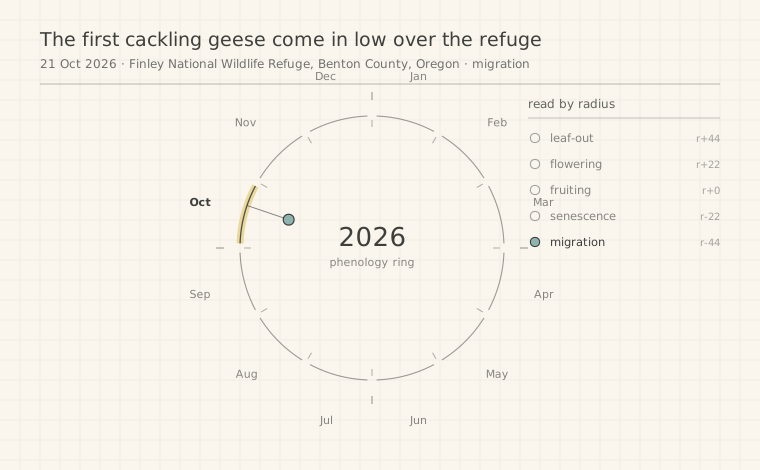
The cackling geese come into the valley in late October, and they come on a north wind. Today the wind was at six metres a second out of the north and four flocks came in low over the ridge between 08:20 and 10:05.
Counting geese that are talking
Counting geese in the air is guesswork. I waited for them to settle on the grass field west of the barn and counted on the ground instead, in blocks of fifty.
- Flock 1, 08:20 — 180 birds, straight into the field.
- Flock 2, 08:55 — 210.
- Flock 3, 09:30 — 160.
- Flock 4, 10:05 — 90, the last and the smallest, and it circled twice before landing.
- Total 640 cackling geese, plus 90 Canada geese on the same field and 12 white-fronted geese with the flock.
A cackling goose is about the size of a mallard with a goose's build, and it sounds like a high, yapping laugh rather than the low honk of a Canada goose. At 300 m I can hear the difference long before I can see it, and the flock on the ground sorted itself out for me: the Canada geese stood a head taller.
What the flock does to the field
Six hundred geese on a grass field are a grazing pressure, and they rotate across it. The field they used today was grazed to about 4 cm and dotted with fresh droppings; the field next to it, which they used for three days last week, is already showing regrowth of about 2 cm.
The refuge manages these fields for exactly this: short grass in autumn for the geese, with the water held back until later. The birds do not need the water yet. They need the grass, and they need to be able to see a falcon coming from a long way off.
A prairie falcon on the fence post at the field edge watched them for ten minutes and took nothing. One immature snow goose was in with the cackling flock, dark rather than white, which is how a first-winter bird of that species looks.
What to check next time
- Count again in a week; the cackling flocks build through November and my highest count here is 2,100.
- Check the fields for grazing height in centimetres each visit, which is a faster way to see the rotation than counting birds.
- Watch for the first swans, which come after the geese and are not on this refuge in numbers until December.
Observed
| Scientific name | Vernacular | Count | Note |
|---|---|---|---|
| Branta hutchinsii | cackling goose | 640 | 640 in four flocks, counted on the ground after they settled |
| Branta canadensis | Canada goose | 90 | 90 on the same field, three times the body mass and half the noise |
| Anser albifrons | greater white-fronted goose | 12 | twelve, with the cackling flock; first of the autumn here |
| Falco mexicanus | prairie falcon | 1 | one on a fence post at the field edge, watching the flock for ten minutes |
| Chen caerulescens | snow goose | 1 | one immature with the cackling geese, dark morph |
Reflection
Two species of goose that most people report as one is a good reason to carry a scope. Voice and size are the honest field marks here, and both need you to stand still and listen rather than count.
Kit carried
- binoculars 8x42
- spotting scope 20-60x
- tally counter
- wind meter
- notebook
- 2H pencil
- thermos